Half of US consumers already use AI-powered search to make buying decisions. McKinsey says brands need a GEO strategy. Here's the part the advice leaves out — and how to close it.
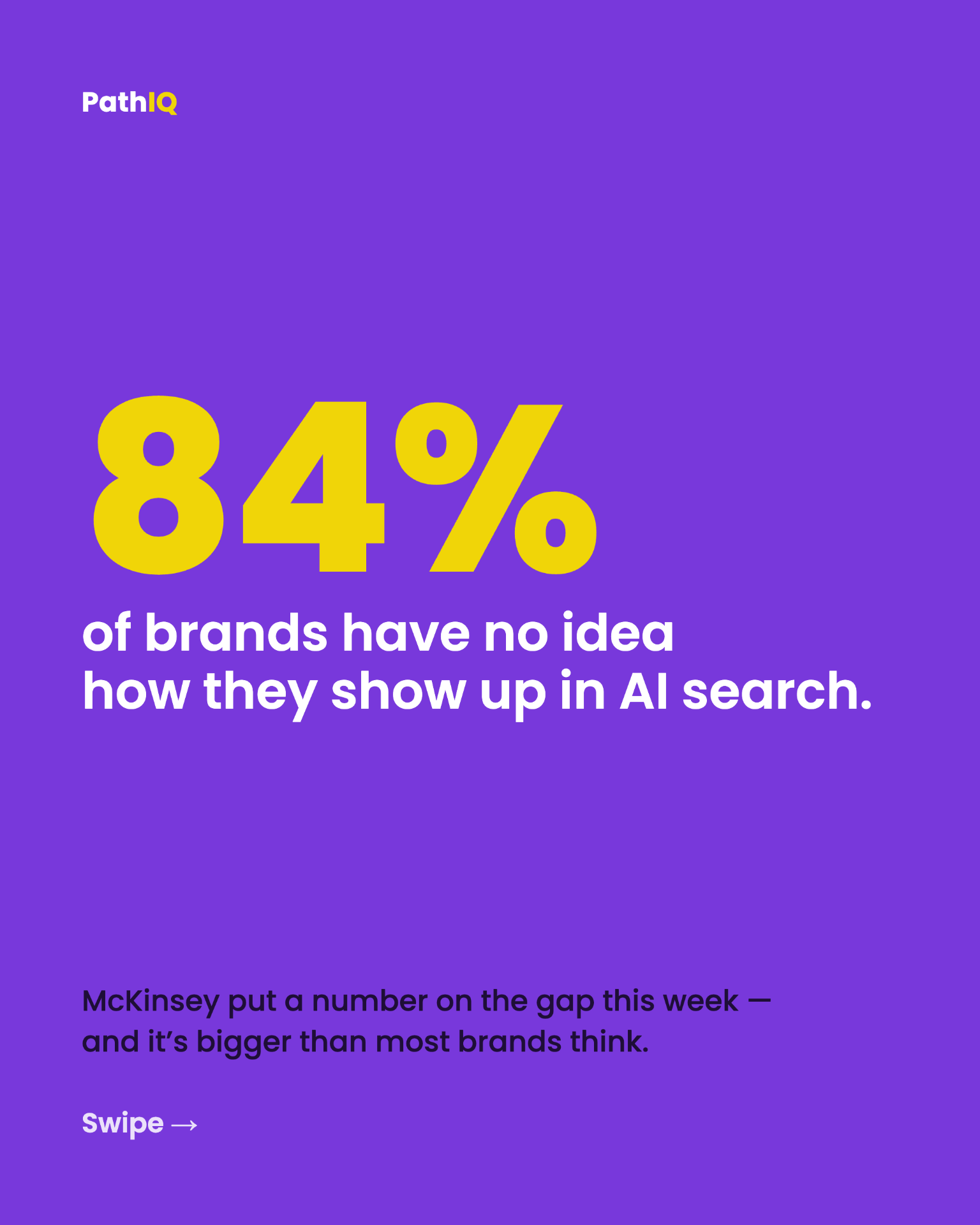
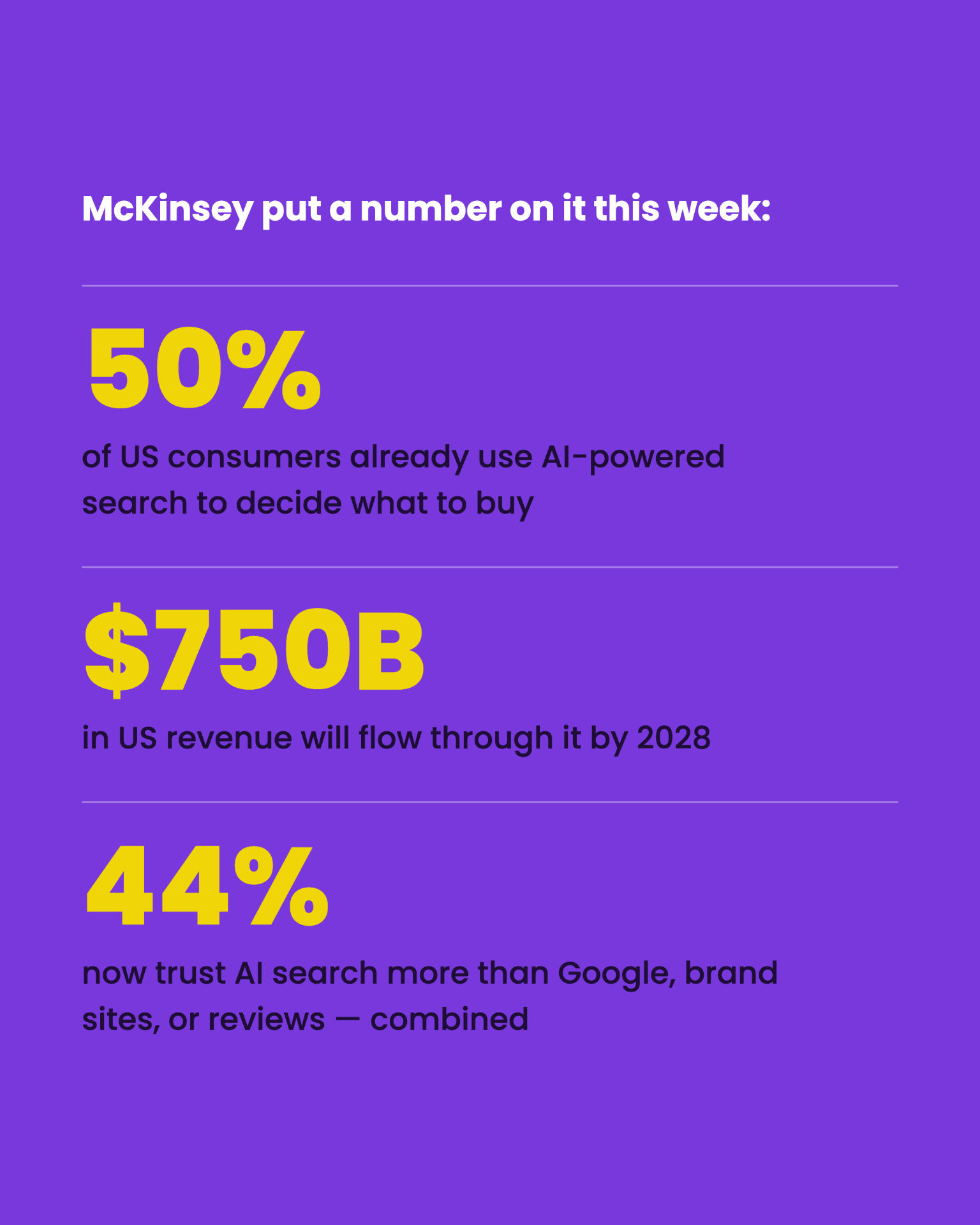
Half of US consumers already turn to AI-powered search — tools like ChatGPT, Gemini, Copilot, Perplexity, and Google's AI Overviews — to research and decide what to buy. Not "will." Already do, according to McKinsey's 2025 AI Discovery Survey. By 2028, McKinsey projects $750 billion in US revenue will flow through AI-powered search.
If you run marketing for a B2B SaaS company, that number isn't abstract. Some share of your pipeline is being decided right now, inside an AI conversation you can't see in GA4, before a prospect ever lands on your site.
McKinsey's answer is directionally right: brands need a gen AI engine optimization (GEO) strategy to sit alongside SEO. But the advice stops one step short of the question every VP Marketing gets asked in a pipeline review: how do you know it's working?
Getting visible in AI search and proving that visibility moved revenue are two different problems. Right now, almost nobody is solving the second one.
The shift your analytics stack can't see
McKinsey's numbers are stark. About half of Google searches already carry AI summaries, on track to pass 75% by 2028. Unprepared brands could see traditional search traffic drop by 20–50% as AI platforms capture purchase decisions earlier in the funnel — before the click that used to show up in your reports ever happens.
Here's the part that should worry marketing leaders more than the traffic decline itself: AI search doesn't mostly pull from your website. McKinsey found that a brand's own site typically makes up only 5–10% of the sources an AI answer engine references. The rest comes from review sites, publishers, forums, and affiliate content — sources most marketing teams have never systematically tracked, let alone attributed to pipeline.
Meanwhile, standard web analytics quietly files AI-referred traffic under "direct," because there's no referrer header to read. That traffic doesn't disappear from your revenue — it disappears from your reporting. It's a dark funnel, and it's growing fast.
Visibility isn't the same as credit
When AI search users were asked which source they trust most for buying decisions, 44% said AI-powered search — ahead of traditional search (31%), retailer or brand sites (9%), and review sites (6%) combined. That's the strongest possible argument for investing in GEO.
It's also the strongest possible argument for measuring it properly. Marketing budgets get cut when a channel can't show its work. A GEO program that improves your brand's presence in AI answers but can't connect that presence to a pipeline number is exactly the kind of initiative that quietly disappears in the next budget cycle — not because it isn't working, but because nobody can prove it is.
Only 16% of brands are even tracking this
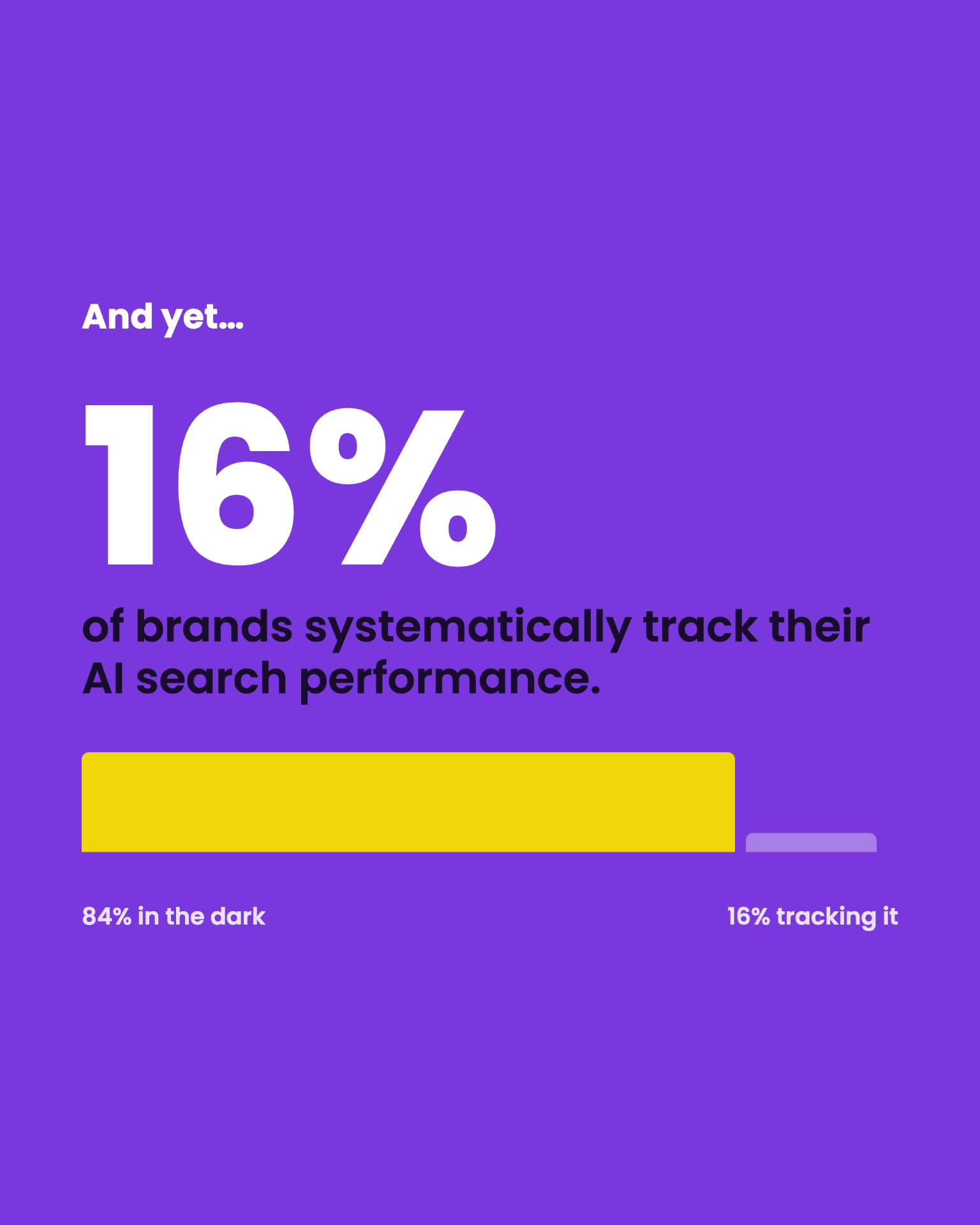
McKinsey's own research found that just 16% of brands systematically track AI search performance today. That's a real gap — but it's also a real opportunity, since most of your competitors haven't built this muscle yet either.
McKinsey lays out four moves to close it: run a diagnostic on current GEO performance, adjust content investment toward the third-party sources AI search actually cites, optimize content structure and credibility for LLMs, and stand up GEO as a cross-functional capability with its own KPIs.
All four are right. What's missing is the connective tissue between "we're now visible in AI search" and "here's what that visibility was worth" — the same connective tissue that separates a content strategy from a revenue strategy.
Closing the loop: from AI mentions to pipeline
The fix isn't a better dashboard for share-of-voice. It's attribution — treating AI mentions the way performance marketers learned to treat any other demand signal, by looking at what happens next.
In practice, that means watching for temporal correlation: spikes in AI mentions of your brand followed by measurable upticks in branded search and direct traffic within a 24–72 hour window. That pattern is the closest thing GEO has to a conversion signal, and it's how you separate "we got mentioned" from "that mention moved pipeline."
This isn't a new problem for marketing measurement, either. A decade ago, connected TV impressions were considered structurally unmeasurable — no click, no cookie, no clean attribution path — until the industry built infrastructure to connect exposure to outcome anyway. AI search visibility is in the same position CTV was in then: high-impact, largely invisible to standard tools, and treated as unmeasurable mostly because nobody has built the measurement layer yet.
What this means for your team this quarter
Three moves, in order:
- Audit where you stand today. Find out which AI platforms mention your brand, in what context, and against which competitors, before you spend a dollar changing your content strategy.
- Instrument mention tracking against revenue signals, not just share-of-voice. A spike in mentions with no downstream demand signal tells you something different than a spike that correlates with a branded-search jump.
- Move now, not once GEO "settles." McKinsey is explicit that source mix shifts by LLM, category, and geography, and will keep shifting as models evolve. Waiting for stability means waiting indefinitely.
GEO is the right strategic call. But a GEO strategy without attribution is a content plan wearing a revenue plan's clothes. The brands that win the next five years of search won't just be the ones who get mentioned by AI — they'll be the ones who can prove what those mentions were worth.
Want to see where your brand currently stands in AI search — and whether those mentions are moving pipeline? Start with a free AI Visibility Audit from Path IQ.
Source: Elizabeth Silliman, Julien Boudet, and Kelsey Robinson, "New front door to the internet: Winning in the age of AI search," McKinsey & Company, October 16, 2025.